
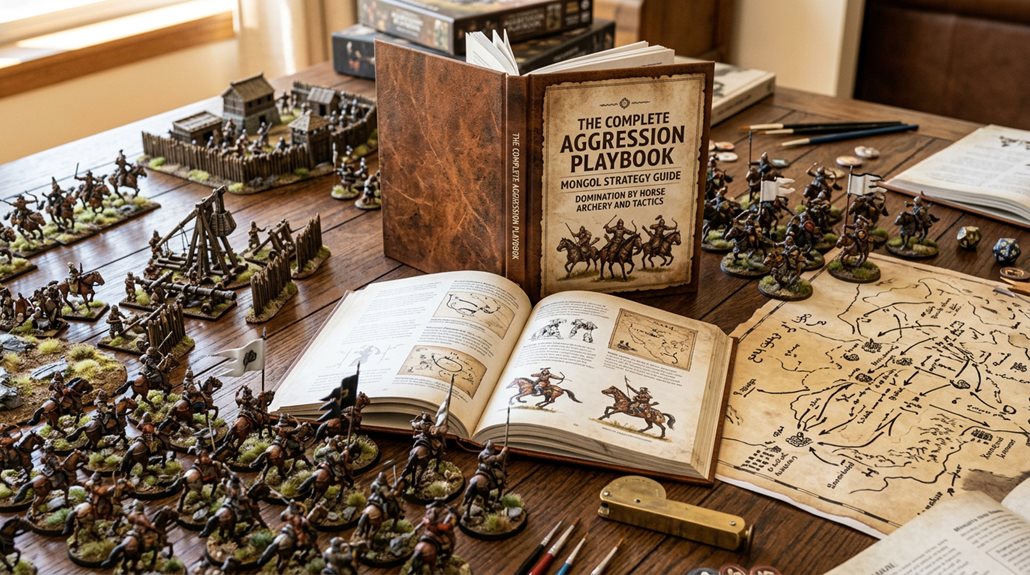
Mongols Strategy Guide: The Complete Aggression Playbook
The Mongols’ strategy revolves around swift mobility, using fast horse-mounted troops and logistical techniques like horse swapping to conduct surprise raids and rapid assaults. They excel in psychological warfare by spreading fear, deception, and propaganda to weaken enemy morale before engaging. Their offensive tactics include hit-and-run attacks, arrow storms, and encircling enemies through double envelopment. To counter these, opponents must control terrain, defend key points, and understand the Mongols’ focus on early expansion, deception, and psychological dominance—further knowledge will help you deepen your comprehension.
Scout Report
- Focus on rapid mobility, surprise attacks, and flanking maneuvers to outmaneuver enemies effectively.
- Utilize cavalry archers for hit-and-run tactics, arrow storms, and encirclement strategies.
- Employ psychological warfare through terror, deception, and propaganda to weaken opponent morale.
- Exploit terrain features like mountain passes and river crossings for strategic advantage.
- Build diplomatic alliances and cultural assimilation to facilitate swift expansion and reduce resistance.
Understanding Mongol Warfare: Core Principles and Strategies

Understanding Mongol warfare involves recognizing their core principles and strategies, which relied heavily on mobility, intelligence, psychological tactics, deception, and strict discipline. They formed diplomatic alliances to expand influence and practiced cultural assimilation to integrate conquered peoples. These strategies allowed the Mongols to outmaneuver enemies quickly, gather crucial information, and maintain control through psychological pressure and disciplined leadership. Their engineer corps rivaled those of Alexander the Great and Julius Caesar, providing strategic depth and flexibility, further enhancing their operational effectiveness. Additionally, their emphasis on military innovation enabled them to adapt swiftly to different combat scenarios and terrain. The Mongols also prioritized rapid mobility, allowing them to execute swift raids and surprise attacks that overwhelmed opponents.
How to Use Mobility and Cavalry for Rapid Attacks
Mobility and cavalry were the key tools that made Mongol rapid attacks highly effective, allowing them to strike quickly and outmaneuver their enemies. Mongols used horse endurance and supply chains to maintain continuous movement. They swapped horses regularly, used natural routes, and coordinated tactics like feigned retreats and flanking maneuvers for swift, sustained assaults. Mastery of logistics enabled their armies to perform these rapid, coordinated strikes over long distances without losing momentum. Additionally, their understanding of terrain advantages allowed them to exploit natural features for optimal positioning and cover during these fast attacks. By integrating supply chain management, they ensured their cavalry remained mobile and ready for successive strikes.
Mastering Hit-and-Run Tactics and Arrow Storm Formations
Excelling at hit-and-run tactics with cavalry archers involves precise timing, speed, and coordination to maximize their effectiveness in battle. Horse archery allows rapid attacks from a distance, firing volleys within 200 to 300 yards before retreating. Implementing age-specific strategies ensures you adapt your tactics to the evolving battlefield conditions. Encirclement tactics create the illusion of surrounding enemies, forcing them to break formation. Quick withdrawals prevent counter-attacks and maintain pressure. Understanding the water civ advantages in your environment can give you additional mobility and strategic options during engagements.
Executing Double Envelopment and Psychological Warfare Strategies

Executing double envelopment involves attacking both sides of the enemy at the same time to surround and trap them, which the Mongols often achieved by sending flanking forces to meet the main army. They also used psychological warfare tactics such as feigned retreats and visual illusions—like fake camps or mounted dummies—to confuse and demoralize their opponents, making them more likely to make mistakes. Additionally, the Mongols’ mastery of AOE2 macOS performance allowed them to execute these strategies efficiently even on complex battlefield scenarios. Their ability to adapt tactics quickly and maintain battlefield coordination was crucial to maintaining their dominance in warfare.
Flanking Enemy Forces
Have you ever wondered how the Mongols managed to surprise and defeat larger or well-fortified armies? They used encirclement tactics and horse archery to flank enemies, creating confusion and fear. Here is a comparison of their tactics:
| Technique | Purpose |
|---|---|
| Flanking forces | Attack sides or rear |
| Timing | Wait for weakness |
| Encirclement | Trap enemies |
| Dummy armies | Deceive opponents |
| Disruption | Break enemy lines |
Psychological Pressure Tactics
The Mongols used psychological pressure tactics to weaken their enemies before and during battles by creating the illusion of overwhelming force and manipulating perceptions. They employed deception similar to medieval courtship’s subtle influence, using phantom armies and false reports.
Like artisan guilds shaping perceptions, they crafted illusions and spread rumors, causing enemies to surrender out of fear and confusion.
Timing Your Attacks: Early Expansion and Strategic Rushes

Timing your attacks effectively involves carefully planning early expansion and strategic rushes to gain advantages over opponents before they can build strong defenses. Focus on establishing camel caravans along key Silk routes to control trade and resources. Expand toward strategic zones like Kiev and Caffa, fortify enemy settlements early, and use scouting networks to detect threats, enabling rapid, targeted assaults. Building a second Town Center in Feudal Age can also significantly accelerate your economy, providing a robust economic lead that compounds into a decisive late game.
Building Effective Mongol Unit Compositions for Flexibility
Building effective Mongol unit compositions for flexibility involves balancing cavalry and archers to adapt to different battlefield situations. Upgrading units enhances mobility, allowing your forces to move quickly and respond to threats efficiently.
Maintaining a ratio of light and heavy cavalry guarantees you can perform reconnaissance, flanking, and shock attacks, making your army versatile and capable of handling various combat scenarios.
Balanced Cavalry and Archers
Have you ever wondered how the Mongols managed to stay flexible and effective on the battlefield? They achieved this through:
- Combining horse archers and light cavalry to harass enemies from a distance while maintaining unit coordination.
- Using mobile formations that allowed swift repositioning and exploitation of enemy weaknesses.
- Deploying heavy cavalry strategically to follow gaps created by archers, ensuring a balanced and adaptable force.
Upgrading for Mobility
Upgrading for mobility involves carefully selecting and improving units to maximize the Mongol army’s ability to move quickly and adapt to changing battlefield conditions.
Focus on horse archery and decentralized command, allowing units like light cavalry to perform recon, screening, and harassment efficiently.
These upgrades support flexible tactics such as feigned retreats and flanking, enhancing overall battlefield effectiveness.
Using Terrain and Fortifications to Gain Geographic Advantage
Using terrain and fortifications effectively can give you a significant advantage in battle by shaping how your forces engage the enemy.
- Natural barriers like rivers and mountains limit enemy movement and create choke points, forcing them into narrow areas.
- Concealment strategies, such as hiding mounted archers behind hills near passes, enable surprise attacks and flank enemy forces.
- Fortified structures strengthen your defenses at critical points, preventing enemy breakthroughs and controlling the battlefield.
Applying Terror Campaigns and Surrender Negotiations to Break Resistance
Why did the Mongols rely heavily on terror campaigns and surrender negotiations to weaken their enemies? They used terror as a strategic tool to create fear, often accompanied by ceremonial rituals and diplomatic gestures that encouraged surrender without fighting.
These tactics involved threats of destruction and mass executions, making resistance less attractive, and promoting submission through intimidation rather rather than negotiation.
How to Defend Against Mongol Strategies With Area Control
Controlling key areas of the battlefield is essential when defending against Mongol strategies, as it limits their ability to maneuver and forces them into unfavorable engagements.
- Use urban barricades and fortified positions around cities to block routes and prevent Mongol cavalry attacks.
- Control river crossings by placing defenses on bridges and fords, forcing battles at narrow choke points.
- Establish defensive lines at natural choke points, such as mountain passes, to create small “killing fields” that slow and weaken advancing Mongols.
Psychological Warfare and Propaganda Tactics in Mongol Conquests
The Mongols excelled in the use of psychological warfare and propaganda to weaken their enemies before any actual fighting took place. They used terror, deception, and fear narratives to encourage surrender.
Often offering cultural assimilation and diplomatic negotiations as alternatives to destruction. These tactics spread rumors, created illusions of larger forces, and employed cruelty to break enemy morale and control populations.
Final Tips for Implementing Mongol Warfare Principles Effectively
Implementing Mongol warfare principles effectively requires careful planning and disciplined execution of their tactics.
- Use camel cavalry for swift raids and reconnaissance, maintaining high mobility and surprise.
- Deploy siege tactics with coordinated firepower and psychological measures to weaken defenses.
- Maintain continuous scout networks and adapt to terrain and weather for ideal maneuvering and deception.
These strategies guarantee maximum efficiency and success in Mongol-style warfare.
GG
By understanding the core principles of Mongol warfare, such as mobility, rapid strikes, and psychological tactics, you can effectively implement their strategies. Using cavalry for quick attacks, employing hit-and-run tactics, and executing double envelopment can overwhelm enemies. Timing your strikes early and applying terror campaigns help weaken resistance. To defend against these strategies, control key areas and counteract psychological warfare. Applying these methods with precision guarantees a strategic edge in warfare scenarios.