
Scout Rush Build Order: Step-by-step For Beginners
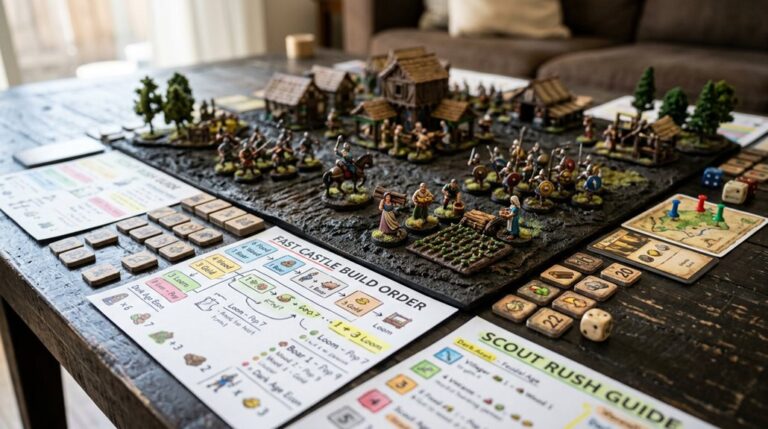
To execute a Scout Rush build order, begin by quickly gathering food from sheep and hunting boars, assigning your villagers efficiently to minimize travel time, and building houses near resource nodes. Train villagers to focus on food and wood, and build a barracks around 50-55% of your shift to the Feudal Age, then immediately construct a stable. Use scouts to locate enemy villagers, disrupt their economy, and develop your army from scouts to archers, progressing seamlessly into the Castle Age for added strength. Continuing will guide you through mastering each step and improving your overall strategy.
Scout Report
- Prioritize quick villager distribution to food sources and build essential structures like houses and a mill early.
- Train 3-4 scouts immediately after advancing to Feudal age to scout enemy positions and disrupt their economy.
- Build a barracks around 50-55% Feudal age, then produce additional scouts for harassment and map control.
- Transition to archers or other units by building archery ranges once scouts are established, maintaining resource flow.
- Focus on timing your Castle Age upgrade while maintaining economy, and shift army composition for sustained pressure.
What Is a Scout Rush and Why Is It Effective for Beginners?

Have you ever wondered what a Scout Rush is and why it can be a useful strategy for beginners in real-time strategy games like Age of Empires 2? A Scout Rush involves quickly using scout units early in medieval warfare, relying on unit micro to locate enemy villagers and disrupt their economy. This strategy helps delay opponents’ tech and improves map control. Additionally, understanding the default control layout on PS5 can help you execute Scout Rush strategies more efficiently by quickly issuing commands and managing units.
Gather Resources and Set Up Your Economy
To establish a strong economy early in the game, you need to focus on distributing your villagers efficiently, prioritizing food and wood collection to sustain your growth. Assign villagers immediately to gather from sheep, boars, berries, and trees, and build essential structures like houses, a mill, and a barracks to support resource gathering. Properly managing these tasks guarantees a steady flow of resources, enabling you to advance quickly and prepare for your scout rush strategy. Additionally, understanding the importance of build orders and their timing can help you decide when to transition between early game strategies.
Efficient Villager Distribution
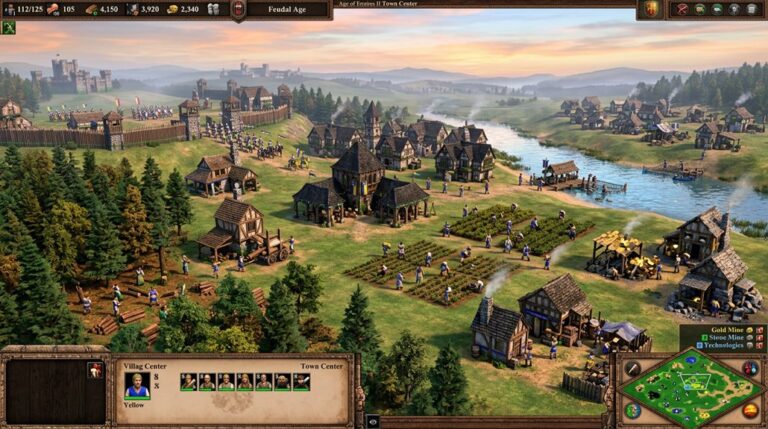
Efficient villager distribution is vital for establishing a strong economy early in the game, and it begins with positioning gather points as close as possible to resource sources. Proper villager placement at resource nodes minimizes walking time, reduces delays, and prevents bumping.
Assigning six villagers per food source and limiting wood and gold guarantees steady collection without inefficiencies.
Prioritize Food and Wood
Why is it important to prioritize food and wood gathering early in the game?
Prioritizing resource allocation for food and wood allows you to quickly reach the 500 food threshold for Feudal age.
Maintaining a steady number of gatherers guarantees economy expansion, supporting construction of essential buildings like barracks and mills, and enabling timely upgrades and scout production for strategic advantage.
Build Early Resource Structures
Building early resource structures forms the foundation of a strong economy by ensuring your villagers can gather essential materials.
Construct two houses immediately, task villagers to gather sheep, and set gathering points before they arrive.
Establish lumber camps near woodlines, assign villagers efficiently, and plan for stone walls.
This setup maintains economic balance and prepares for future defenses.
When and How to Build Your Barracks and Stable
To effectively develop your military infrastructure during the Feudal Age, you need to carefully time the construction of your Barracks and Stable, considering both their strategic placement and resource requirements.
Build the Barracks around 50-55% Feudal progress with 1 villager, and the Stable immediately at Feudal click.
Placing both near wood sources and away from early scout raids for safety is recommended.
Additionally, understanding the archer civilization strengths and weaknesses can help you decide which units to prioritize as you advance your military strategy.
Luring and Securing the Boar for Food

When luring and securing the boar, you must approach carefully to avoid provoking its attack and guarantee successful food gathering. You need to shoot the boar exactly twice with a villager and immediately return to the Town Center after the second shot to prevent the boar from attacking. Proper setup, such as placing a house nearby and using sheep to block the boar’s path, helps keep the villager safe during the process. Additionally, understanding the disruption of build orders allows you to adapt your strategy effectively if the process is interrupted by a raid or rush.
Approaching the Boar Carefully
Approaching a boar carefully is vital to prevent provoking its defensive instincts and guarantee a safe luring process.
By understanding boar behavior, you should maintain a distance of 15 to 20 meters, move slowly, and watch for alert signals like ear rotation or tail twitching.
Proper fencing techniques are essential to contain the boar once it shows signs of awareness or aggression.
Properly Luring the Animal
Properly luring the boar involves carefully using a single villager as the main attractant, or “lure,” to guide the animal toward the Town Center for food collection.
Think of it as treasure hunting, where villager positioning is vital.
You must shoot the boar twice, then retreat immediately to trigger follow behavior and guarantee the boar follows efficiently without attacking.
Training Your First Scouts and Managing Their Movements

Training your first scouts and managing their movements effectively is essential for gaining early map control and applying pressure on your opponent. Use proper scout formation to quickly reveal enemy positioning, locate key resources, and identify enemy forward villagers. Attack strategically, focus on enemy scouts with low health, and pull back when necessary to preserve units. Maintaining control and awareness throughout early engagements is crucial for a successful start. Additionally, understanding the most-effective build orders for scout rushes can help optimize your opening and improve your chances of success.
Expanding Your Economy With Farms and Balancing Resources
Efficient farm placement is essential for maintaining a steady resource flow, so you should build farms near trees and berry bushes to maximize gathering speed.
Balancing resource collection involves assigning villagers appropriately—such as 10 to wood, 18 to food, and 5 to gold—while ensuring farms are built in the proper sequence.
For example, constructing at least 15 farms before switching to gold mining is recommended.
Proper timing of farm construction and resource allocation allows your economy to grow smoothly, supporting your military and technological advancements without unnecessary delays.
Additionally, understanding the Feral Interactive port can help you optimize game performance and stability on macOS.
Efficient Farm Placement Strategies
To maximize your economy, careful placement of farms relative to the mill and town center is essential.
Focus on farm placement on the right side of the mill to reduce travel time and improve resource optimization.
Starting farm lines from corners and maintaining consistent right-side flow prevents bottlenecks, ensuring efficient harvesting and steady resource flow during expansion.
Balancing Resource Gathering
Balancing resource gathering involves managing how you allocate your villagers and structures to make certain a steady flow of both wood and minerals, which are essential for growth and unit production.
Farm placement near the Town Center reduces travel time.
Resource balancing guarantees you don’t overproduce minerals or underuse farms.
Proper expansion with farms supports macro and efficient resource management.
Key Upgrades: Horse Collar, Loom, and Double-bit Axe-When and Why
The timing and reasons for researching key upgrades like Horse Collar, Loom, and Double-bit Axe are vital for an effective Scout Rush build. Loom timing is essential, as researching it immediately upon reaching 100 food prevents villager deaths and food loss, ensuring a safe shift to Feudal Age. Horse Collar benefits include increased mill efficiency, enabling faster farm development after securing the Feudal Age. Additionally, understanding civilization differences can help players optimize their upgrade choices based on the unique strengths and strategies of each civilization.
Advancing to Castle Age: Timing and Preparations
Successfully reaching the Castle Age requires careful planning and timing, especially after executing a Scout Rush that disrupts the enemy’s economy. Focus on economy management by maintaining at least 15 farms, prioritizing gold and wood for upgrades and units. Proper resource allocation involves balancing food, gold, and wood, ensuring constant villager production and preparing for Castle Age upgrades without risking economic collapse. To optimize your timing, consider build order efficiency and how it impacts your overall strategy.
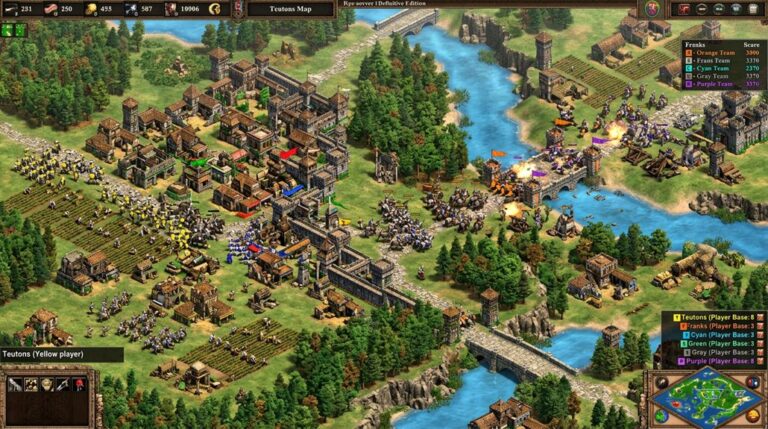
Fortifying Your Base: Walls and Defensive Measures
Have you ever wondered how to make your base more secure against enemy attacks? Effective fortification techniques rely on strategic placement of walls, terrain, and materials.
- Use layered defenses, such as outer palisades and inner stone walls, to create redundancy.
- Incorporate terrain elevation and natural features to enhance visibility and reduce construction.
- Install integrated turrets and traps for automated enemy detection and damage.
- Prioritize early castle-age upgrades to maximize cavalry damage and strengthen your defenses during critical moments.
These measures improve defensive placement and strengthen your base’s resilience.
Transitioning Your Army: From Scouts to Archers
Switching your army from scouts to archers is a crucial step in developing a balanced and effective military strategy during the Feudal Age.
You should start building archery ranges after producing 3-4 scouts and aim to upgrade to castle age.
Maintain steady resource flow, especially wood and food, to prevent economic bottlenecks and prepare for potential medieval siege threats.
Managing Resources and Army During the Castle Age Push
Managing your resources effectively during the Castle Age push is vital to building a strong and balanced army while maintaining economic stability.
- Focus on gold management by assigning at least 15 villagers to gold early, maintaining 18–20 gold farmers, and prioritizing the gold mining upgrade.
- Balance wood and food by producing 20–22 farms, upgrading blacksmiths, and maintaining consistent wood flow.
- Time upgrades like Bloodlines and Knight armor before 14:00 to guarantee efficient resource management and sustained economic growth.
Final Tips: Avoid Common Mistakes and Adapt to Opponents
To succeed in a Scout Rush, it’s essential to avoid mistakes that weaken your economy and expose vulnerabilities. Focus on efficient trade routes, which improve resource flow, and consider cultural influences that affect unit strength and building speed.
Adapt your strategy based on opponent actions, balancing economy and defense, to prevent resource shortages and maintain map control throughout the game.
Review and Improve: Analyzing Your Scout Rush Performance
Analyzing your Scout Rush performance is essential to identify areas for improvement and guarantee your strategy remains effective throughout the game.
- Focus on economy balancing by verifying villager count and farm placement to maximize resource gathering.
- Improve scout micro by practicing uphill attacks and target prioritization to maintain micro advantage.
- Assess resource denial tactics like harassment and timing to disrupt enemy growth and adapt your approach accordingly.
Frequently Asked Questions
How Do I Decide the Right Timing to Transition From Scouts to Archers?
You decide the right timing to shift from scouts to archers by analyzing your military timing, ensuring enough farms and gold income, and monitoring enemy defenses. Proper resource management and timing maximize efficiency and aggression effectiveness in your strategy.
What Are the Best Ways to Scout My Opponent’s Base Early On?
To scout early, manage your resources efficiently and send a worker at the right time, observing enemy patterns like expansion and tech choices. Use control groups and patrols to gather intel without overcommitting.
When Should I Start Building Walls for Defense During a Scout Rush?
You should start wall timing immediately after clicking up to Feudal Age if you see an opponent’s scout rushing. An early defense setup, like quick palisades around key resources, prevents enemy units from gaining access before their attack arrives.
How Many Villagers Should I Allocate to Resources During the Rush?
During a scout rush, focus on economic management by allocating about 6-8 villagers to food and wood, ensuring scout timing stays ideal. Balance resource gathering to maintain pressure and build defenses without delaying your early attack strategy.
What Are Common Mistakes to Avoid When Executing a Scout Rush?
To avoid mistakes in a scout rush, focus on resource management and timing optimization. Don’t delay building houses, misallocate villagers, or build structures too early or late. Balance economy and military, and scout micro effectively for success.
GG
A scout rush is an effective strategy for beginners because it allows you to gather early information and pressure your opponent quickly. By efficiently managing resources, building the right structures at the right time, and training the appropriate units, you can gain a strong early advantage. It’s important to adapt your approach based on your opponent’s actions and avoid common mistakes. Regularly reviewing your gameplay helps you identify areas for improvement and refine your tactics for better results.