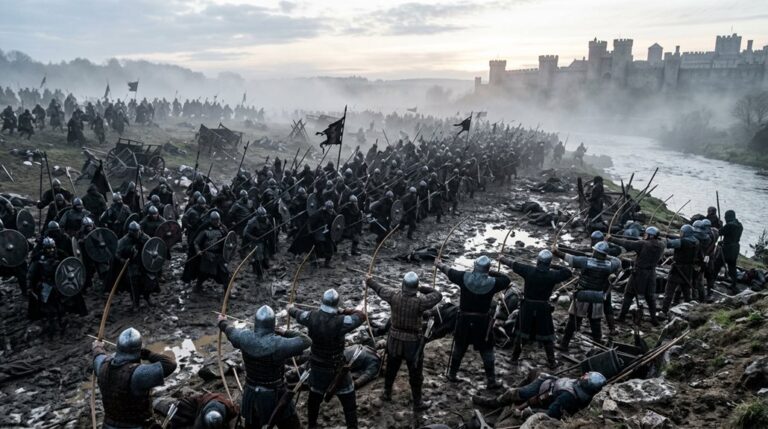
AOE2 Civilization Tier List 2026
The Age of Empires II civilization tier list in 2026 ranks civilizations based on their strengths, weaknesses, and current meta, considering recent updates and new DLC, like the South American civilizations. Top-tier civilizations such as Incas, Shu, and Wu excel due to their strategic advantages, while S-tier civs dominate early-game with economic and military strengths. A-tier civilizations are versatile and adaptable, whereas B- and C-tier ones face challenges in scaling and late-game performance. Understanding these rankings can help you make better choices, and exploring further reveals how strategic factors impact the overall balance.
Scout Report
- The top civilizations like Incas, Shu, and Wu excel due to strategic strengths, unique units, and high win rates in 2026.
- S-tier civilizations focus on early-game economy, infantry, and map control, dominating meta and competitive play.
- Mid-tier civilizations offer versatility with balanced tech trees, suitable for varied strategies and late-game strength.
- Water and island strategies depend heavily on early dock uptime, fishing efficiency, and map control tactics.
- Tier lists guide players in choosing civilizations based on strengths, weaknesses, matchup dynamics, and strategic flexibility in 2026.
Introduction: The State of Age of Empires II in 2026

Are you curious about the current state of Age of Empires II in 2026? The game remains a leading esports title, with over 200,000 active players monthly. Recent updates introduced technological innovations like new unique techs for Portuguese and adjustments to mechanics. These changes enhance the game’s historical accuracy and strategic depth, keeping the game relevant and engaging in 2026. The evolving civilization strategies continue to challenge players and keep the competitive scene vibrant.
What Are the Top Civilizations in Age of Empires II for 2026?
In 2026, the top civilizations in Age of Empires II are determined by their win rates, strategic strengths, and popularity in the current meta. Civilizations like Inca, Shu, and Wu lead due to their historical civ evolution and cultural influence that shape their unique units and strategies. These factors contribute to their high performance in both solo and team games. Furthermore, the effectiveness of a civ’s synergy between quirks, units, and tech bonuses plays a crucial role in their overall competitiveness. Understanding the unique units and tech tree highlights of each civilization can provide strategic advantages and improve overall gameplay.
How Do S-Tier Civilizations Dominate the Meta in 2026?
S-Tier civilizations dominate the Age of Empires II meta in 2026 mainly because they excel at leveraging early-game strengths, particularly through infantry and lumber efficiency.
- They maximize economic dominance by early lumberjacking and food collection, enabling rapid unit production.
- Unit versatility allows them to adapt to different strategies, counter opponents, and control the map effectively.
- Specialized units provide advantages in combat, increasing their overall strength.
- Consistent win rates across ELO ranges reinforce their dominance in the meta.
- Their ability to capitalize on civilization bonuses further cements their status as top-tier choices.
What Makes A-Tier Civilizations Versatile and Valuable?

A-Tier civilizations are considered adaptable and indispensable because they offer a well-rounded tech tree and a wide range of units that allow for flexible strategies throughout the game. Their unit cohesion and tech progression enable balanced offensive and defensive options, economic efficiency, and late-game strength. These civilizations excel in adapting to various situations, making them beneficial across different playstyles. Additionally, their focus on phalanx-focused units provides a distinct tactical advantage in certain matchups.
Which B-Tier Civilizations Excel in Specific Strategies?
Chinese civilizations excel in using stacked Chu Ko Nu, which provide strong ranged attack support and can hold off enemy cavalry with layered defenses. This makes them effective in both offense and defense. A well-timed build order can maximize their durability and damage output during key battles. Franks are known for their early axeman tactics, such as throwing axemen, which disrupt enemy cavalry charges and establish control during the initial phases of the game. Lithuanians focus on cavalry, combining mobility and resilience through their Leitis. This is a versatile unit that can adapt to various combat situations and support fast, aggressive strategies.
Chinese’s Stacked Chu Ko Nu
When considering the strengths of B-Tier civilizations in Age of Empires 2, the Chinese stand out because of their unique Chu Ko Nu, a unit that specializes in rapid, repeated ranged attacks.
- Fires three arrows per attack cycle with minimal delay.
- Offers a 22% damage advantage in archery PvP scenarios.
- Has a range of 2, matching standard archers.
- Achieves a 72% win rate against melee civilizations.
Franks’ Early Axeman Tactics
The Franks excel in early game strategies that employ their unique bonus of free throwing axemen, which can be produced without incurring additional costs. Their focus on early aggression and resource management allows rapid expansion. Use this table to understand how Frank’s axemen provide high melee armor and effective map control, supporting quick economic growth and defensive stability.
| Advantage | Application |
|---|---|
| Free throwing axemen | Early aggression, resource saving |
| Extra range (5) | Better combat against archers |
| Low gold dependency | Efficient resource management |
| High melee armor | Defense against spearmen |
| Early map control | Secure expansion opportunities |
Lithuanians’ Cavalry Focus
Lithuanians are considered a B-tier civilization in Age of Empires 2 because of their strong focus on cavalry-based strategies, supported by unique mechanics and bonuses.
- They start with +150 food, enhancing early cavalry production.
- Relic control grants +1 attack per relic, capped at +5, improving cavalry damage.
- Monasteries operate 20% faster, accelerating relic collection.
- Cavalry upgrades benefit from relic bonuses, strengthening late-game units.
Why Do C-Tier Civilizations Struggle in the Current Meta?
C-tier civilizations often struggle in the current meta because they lack strong economic bonuses, leading to economic stagnation and slower resource gathering. This makes early-game pressure difficult and hampers long-term growth.
Additionally, military weaknesses, such as weaker units and less effective defenses, reduce their ability to compete against top-tier civilizations, leading to frequent defeats and poor performance overall. A lack of archer versatility can also limit their effectiveness on different map types, further hindering their competitiveness.
Which Civilizations Are the Weakest and Why Need Major Updates?

Many civilizations in Age of Empires II currently struggle because they’ve outdated unit mechanics that don’t perform well with the modern game meta, making their armies less effective in battles.
Additionally, most of these civilizations lack unique bonuses that could give them advantages or special strategies, which further limits their competitiveness.
Finally, poor opportunities for late-game development prevent these civilizations from scaling into stronger forces, highlighting the need for major updates to improve their balance and viability.
A better understanding of unit roles and mechanics could help identify ways to enhance these civilizations and diversify their strategic options.
Outdated Unit Mechanics
Why are certain civilizations in Age of Empires II considered the weakest, and how do outdated unit mechanics contribute to this status? Outdated mechanics weaken unit effectiveness, hindering unit balance and requiring a mechanic overhaul.
- Bulgarians’ Konnik lacks armor piercing.
- Sicilians’ Serjeant has outdated damage.
- Celts’ Woad Raider has low counter viability.
- Huns’ Tarkan needs armor piercing updates.
Lack of Unique Bonuses
Certain civilizations in Age of Empires II are considered weaker because they lack map-specific or mode-specific bonuses that could give them an advantage in particular situations.
Without unique bonuses aligned with map mechanics, these civilizations struggle to adapt effectively.
For example, Persians, Mongols, and Spanish lack map-tailored mechanics, which limits their competitive potential in diverse scenarios and reduces strategic flexibility.
Poor Late-Game Opportunities
Many civilizations in Age of Empires II face significant challenges during the late game because their bonuses and units don’t scale well as the game progresses.
- Barbados suffers from weak economy bonuses, leading to economic imbalances.
- Bulgaria lacks defensive structures, reducing late-game survivability.
- Carolinas miss unique late-phase units, limiting late-game options.
- Teutons experience poor late-game bonus scaling, weakening their overall performance.
How Will the ‘The Last Chieftains’ DLC Impact AoE II Civilizations?
The ‘The Last Chieftains’ DLC is set to substantially influence Age of Empires II (AoE2) by introducing three new South American civilizations—Mapuche, Muisca, and Tupi—that expand the game’s diversity and strategic options. These additions enhance cultural influences and provide fresh gameplay choices, but balanced integration is vital to prevent disrupting game balance and guarantee fair competition among civilizations. Additionally, the effectiveness of these civilizations will depend on how well their unique abilities and strengths are integrated into gameplay, ensuring they complement rather than overshadow existing civilizations.
How Water and Island Strategies Influence Civilization Tiers?
Water and island strategies have a significant impact on how civilizations are ranked in Age of Empires II, especially on maps where water plays a dominant role.
- Water dominance requires early dock uptime for economic advantage.
- Fishing ships greatly increase resource income, impacting tier placement.
- Civs like Dravidians excel due to tech scaling on hybrid maps.
- Island strategies depend on map control and defensive tactics, influencing civilization strength.
- Understanding dock timings and galley transitions is crucial for optimizing water-based strategies and elevating civilization performance.
What Factors Make a Civilization Strong in 2026?
A civilization’s strength in 2026 depends heavily on its ability to develop and maintain a strong economy while remaining adaptable to various strategies.
Effective economic strategies involve prioritizing resource collection, building multiple Town Centers, and managing resources through market trades.
Defensive structures like walls and towers also enhance survival, allowing you to defend your economy and adapt to enemy attacks efficiently.
How Can Tier Lists Help You Pick the Best Civilizations for Your Playstyle?
Tier lists serve as essential tools in helping players choose civilizations that match their preferred playstyle by clearly mapping each civilization’s strengths and weaknesses. They help you understand:
- How unit coordination aligns with your strategy, like heavy cavalry for offense.
- The economic efficiency required for early or late-game success.
- Age-transition speeds suitable for quick or steady progression.
- Matchup win rates that support aggressive or defensive tactics.
Tips for Choosing the Right Civilization in Competitive Play
When choosing a civilization for competitive play, you should consider its matchup strengths and weaknesses against other civilizations. This can influence your overall strategy and success.
It’s also important to evaluate the map type and team interactions, since certain civilizations perform better on specific maps or in team settings due to their unique abilities.
Matchup Strengths and Weaknesses
Understanding the strengths and weaknesses of different civilizations in Age of Empires II is essential for making strategic choices in competitive play.
- Consider unit coordination—some civilizations excel with specific units, like Mongols against archers.
- Recognize matchup dominance, such as Franks in 3v3 with throwing axemen.
- Evaluate civilizations balance—weaknesses in map-specific or meta-shift scenarios affect overall effectiveness.
- Use this knowledge to optimize civilizational strengths and cover weaknesses effectively.
Map and Team Dynamics
Choosing the right civilization in competitive Age of Empires II depends heavily on the map type and team composition, as each factor influences which civilizations can perform best in specific scenarios.
Terrain strategies and team harmony are vital; for example, Mongols excel on open maps with mobility, while Teutons dominate defensive terrain.
Selecting civilizations aligned with terrain and team needs improves chances of success.
GG
In summary, understanding the tier list for Age of Empires II in 2026 helps you select civilizations that match your playstyle and strategic goals. S-tier civilizations dominate the meta with strong, versatile options, while A- and B-tier civilizations excel in specific strategies or environments. Considering factors like water maps and unique strengths can improve your chances of success. Using this information allows you to make informed decisions, enhancing your gameplay and competitiveness in the game.